


Mid-Face Lift
Mid-Face Lift
A mid-face lift aims to address the downward displacement of cheek tissue and the tired appearance in the area where the under-eye region meets the cheeks. The aim is not to alter the face or create an exaggerated fullness; rather, it is to provide a more rested, soft and natural appearance by supporting the mid-face region in a way that is suited to the individual’s anatomy.
Contents
- What is a Midface Lift?
- In Which Situations Is a Mid-Face Lift Recommended?
- What Techniques Are Available?
- How is the operation performed?
- How Long Do the Results Last?
- Where Do the Traces Remain, and How Visible Are They?
- Frequently Asked Questions
Type of anaesthesia:
General
Duration of the operation:
2 hours
Hospital Stay:
1 day
Stay in Istanbul:
5 days
Return to Life:
10 Days

What is a Midface Lift?
A mid-face lift is a surgical procedure that targets the mid-face anatomy, extending from the lower eyelid to the corners of the mouth. By repositioning the deep fat pad (SOOF) over the cheekbones—which shifts with age—it enhances the definition of the cheekbones, corrects under-eye hollows and reduces the depth of smile lines.
In Which Situations Is a Mid-Face Lift Recommended?
- Cheekbone Volume Loss: Conditions in which the mid-face becomes flatter and loses volume due to the downward displacement of cheek tissue.
- Under-Eye Hollows and Bags: Where the transition line between the under-eye area and the cheeks becomes deeper and more pronounced.
- Deepened Laughter Lines (Nasolabial Folds): Where the lines running from the sides of the nose down to the corners of the mouth become more pronounced, giving the face a tired appearance.
- Drooping of the Corners of the Mouth: A condition in which the corners of the mouth droop due to pressure from the cheek tissue.
- Candidates with a Firm Lower Face: Individuals who do not yet have noticeable sagging along the jawline or neck, but who are experiencing volume loss and sagging in the mid-face.

What Techniques Are Available?
Endoscopic Mid-Face Lift:
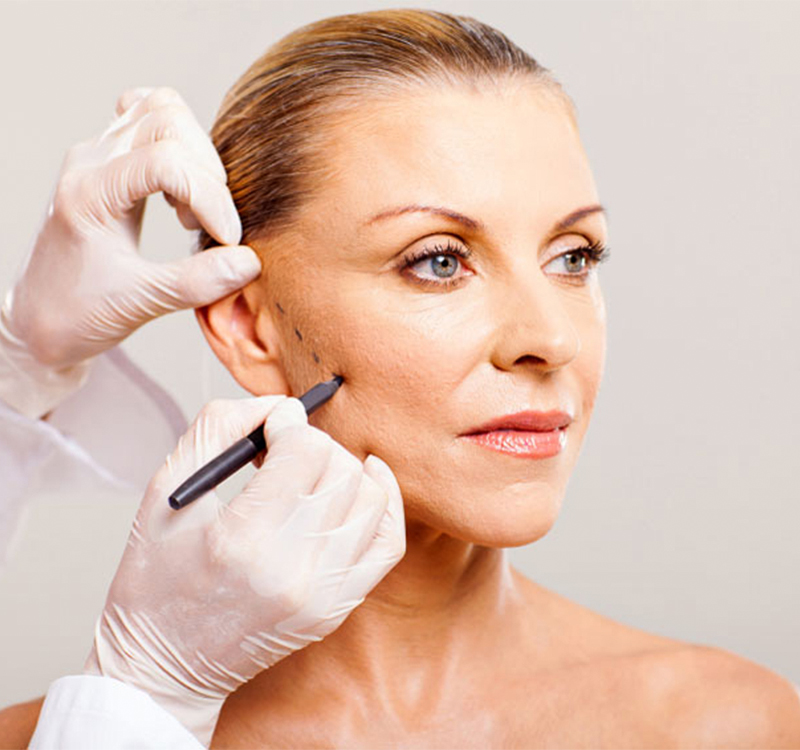
This technique involves making micro-incisions in the scalp in the temple region and, using camera-equipped systems (endoscopes), accessing the mid-face tissues to release them from the underlying bone and lift them vertically upwards. It leaves no scars and speeds up the recovery process.
Subciliary Approach:
This technique involves accessing the mid-face tissues via an incision made at the base of the eyelashes, in combination with lower eyelid surgery (blepharoplasty).
How is the operation performed?
The operation is carried out under general anaesthesia and lasts an average of 2–3 hours, depending on the technique chosen.
- Incision and Access: In the endoscopic technique, micro-incisions are made in the scalp (or, if the procedure is performed concurrently with lower eyelid surgery, an incision is made beneath the eyelashes).
- Tissue Release: With the aid of an endoscopic camera, the fat and muscle tissues on the cheekbone that have lost their mobility and have slipped downwards are released in accordance with the anatomical plane.
- Vertical Vector Suspension: The released tissues are lifted upwards along the vertical axis and securely fixed to the deep fascia.
- Closure: The incisions are closed using aesthetic sutures or surgical staples.

How Long Do the Results Last?
In a mid-face lift, the tissues are not secured using temporary devices such as threads, but are surgically released and anchored to the deeper tissues; consequently, the results are extremely long-lasting. The rejuvenating effect achieved generally lasts for between 7 and 10 years.
Where Do the Traces Remain, and How Visible Are They?
- With the endoscopic method: As the incisions are made entirely within the scalp, no surgical scars are visible from the outside.
- In the ‘Under-Eyelash’ Technique: The incision is concealed just beneath the lower eyelashes and, once healing is complete, blends in with the natural skin crease, becoming virtually invisible.

Frequently Asked Questions
How long does the recovery process take?
Mild swelling or bruising may occur around the cheeks and eyes during the first few days following the operation. The stitches or staples are removed within 7–10 days, and the patient can comfortably resume their daily social life.
Will there be any swelling on my face that looks artificial or as though it’s been injected?
No. Unlike filler treatments, no synthetic volume is added from the outside; an extremely natural fullness is achieved because the person’s own natural cheek and fat tissue is repositioned to where it should be in youth.
How many days do I need to stay in Istanbul for this operation?
For patients coming from outside the city or from abroad, a stay in Istanbul of 6–7 days in total—including pre-operative tests, the operation and follow-up appointments—is sufficient.
Patient Experiences
Hear about the surgical experiences of our patients in their own words.