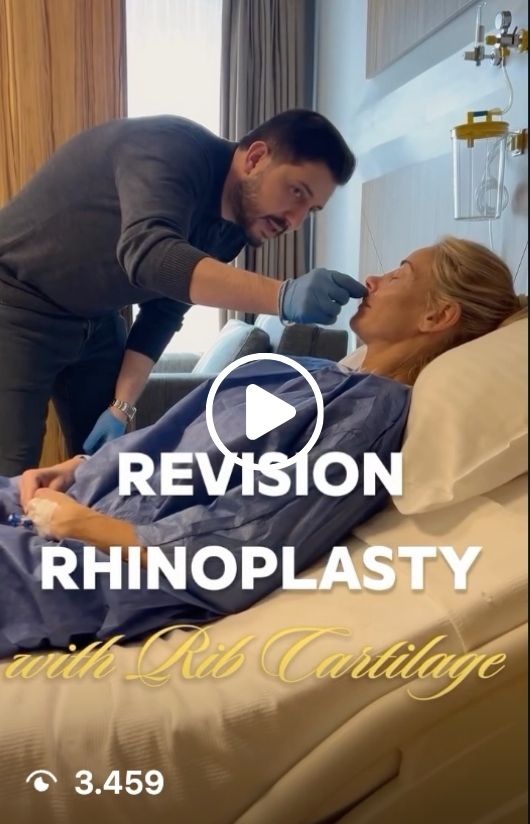



Revision Rhinoplasty
Revision Rhinoplasty
Revision rhinoplasty; Aesthetics after previous nose surgeries
or a more complex surgery aimed at correcting functional problems
is the process.
In these operations, the existing anatomical structure, skin quality, effects of previous surgeries and
support mechanisms are evaluated in detail.
Contents
- What Is Revision (Secondary) Rhinoplasty?
- Who Undergoes Revision Rhinoplasty?
- Which Problems Can Be Corrected with Revision Rhinoplasty?
- When Can Revision Rhinoplasty Be Performed?
- Revision Rhinoplasty in Istanbul
- Frequently Asked Questions
Anesthesia Type:
General
Surgery Duration:
2 Hours
Hospital Stay:
1 Day
Stay in Istanbul:
5 Days
Return to Life:
7 Days
What Is Revision (Secondary) Rhinoplasty?
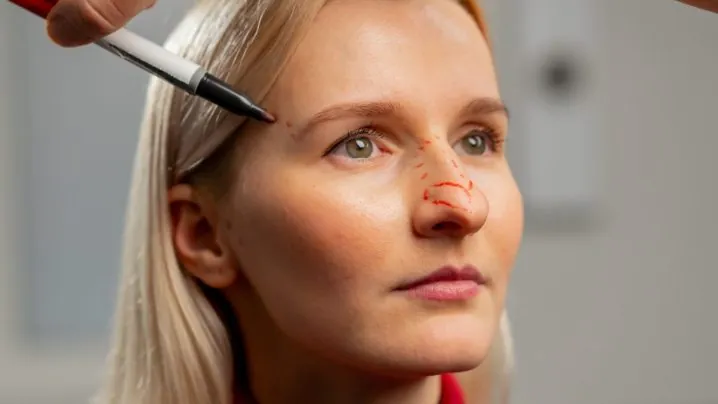
Revision (secondary) rhinoplasty is the name given to surgeries performed in patients who have previously undergone one or more rhinoplasty surgeries, in order to correct aesthetic dissatisfaction or respiratory problems remaining from the first operation. It is a special surgical process that aims to eliminate tissue losses, asymmetries or collapse problems that develop after the first surgery, and requires high experience and precise planning.
Who Undergoes Revision Rhinoplasty?
Revision rhinoplasty surgery is suitable for people whose aesthetic and functional expectations are not met after the first operation. The candidate profile generally includes:
Those Who Experience Aesthetic Dissatisfaction:
Those with irregularity on the back of the nose, excessive hollowness, drooping nose tip or asymmetry.
Those Who Continue to Experience Breathing Problems:
Those who cannot breathe comfortably after the first surgery due to intranasal stenosis or cartilage collapse.
Those Who Have Experienced Trauma or Impact:
Patients who received a blow to the nose area during or after the healing process.
Those with Combined Issues:
Patients who experience both breathing difficulty and deformity simultaneously.

Which Problems Can Be Corrected with Revision Rhinoplasty?
By evaluating the anatomical structure and existing tissue quality in revision surgeries, the following common problems can be successfully resolved:
- Inverted V Deformity and Collapses: Repair of depressions formed at the junction of the nasal bone and cartilage.
- Drooping Nose Tip or Excessive Lift: Bringing the tip of the nose to an angle appropriate to the natural and facial proportions.
- Asymmetry and Curvatures: Correction of curvatures and axis shifts in the nasal axis.
- Beak Nose (Pollybeak) Deformity: Removal of the swelling just above the tip of the nose.
- Cartilage and Airway Stenosis: Strengthening cartilage deficiencies that block the respiratory tract with cartilage grafts taken from the ear or rib.
When Can Revision Rhinoplasty Be Performed?
It is vital that sufficient time passes since the first surgery before the decision for revision surgery is made. At least 1 year should be waited for the nasal tissues to heal completely, the edema to dissipate and the cartilage structure to take its final shape.
In cases of severe obstruction or severe deformation, this period can be specially planned according to the surgeon's evaluation.


Revision Rhinoplasty in Istanbul
Istanbul hosts world-renowned surgeons who specialize in revision rhinoplasty. Istanbul, with its state-of-the-art clinical infrastructure, 3D simulation facilities and operating room conditions at international standards; It is one of the most preferred medical centers for difficult and sensitive revision processes. Patients from all over the world and Türkiye experience a comfortable recovery and high success rate.
Frequently Asked Questions
Is revision rhinoplasty more difficult than the initial surgery?
It is technically more complex due to the changed anatomical structure and the presence of scar tissue. However, under the management of an experienced surgeon, very comfortable and successful results can be achieved.
Does removing cartilage from the rib or ear leave a scar or is it painful?
Since the small incisions made behind the ear or under the breast are placed in hidden folds, there are no visible scars. Mild pain that may occur after the procedure is easily managed with standard painkillers.
How long does the post-operative recovery process take?
Splints and tapes are usually removed within 7-10 days. While most of the swelling goes down in the first few weeks, it may take 1 to 1.5 years for the nose to take its full shape.
How is anesthesia administered during revision rhinoplasty surgery?
The procedure is performed under general anesthesia in a fully equipped operating room environment for the comfort and safety of the patient.

Patient Experiences
Hear the surgery experiences of our guests who choose us in their own words.